

INVESTOR READINESS · FUNDING · STARTUP STRATEGY
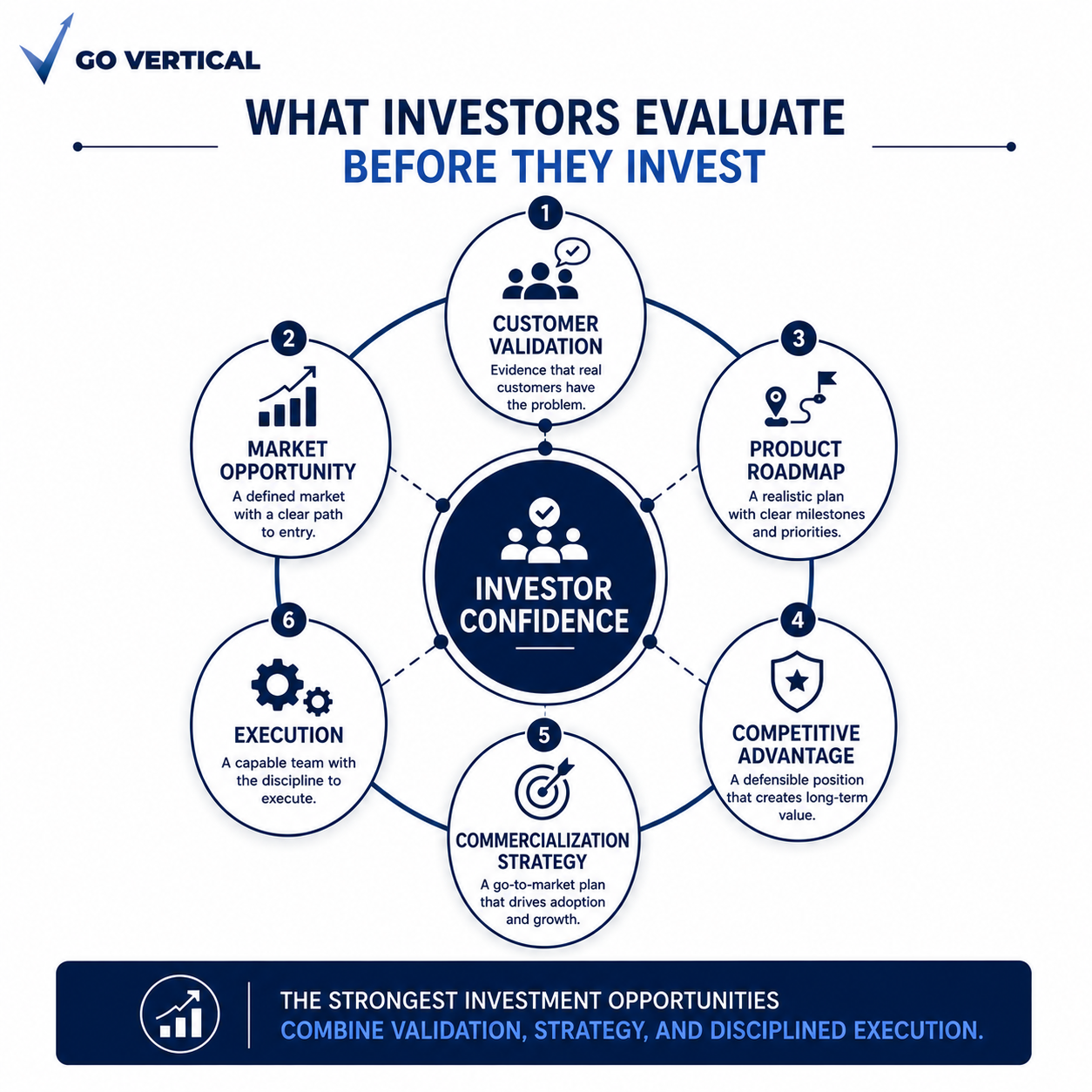
What Investors Evaluate Before They Say Yes
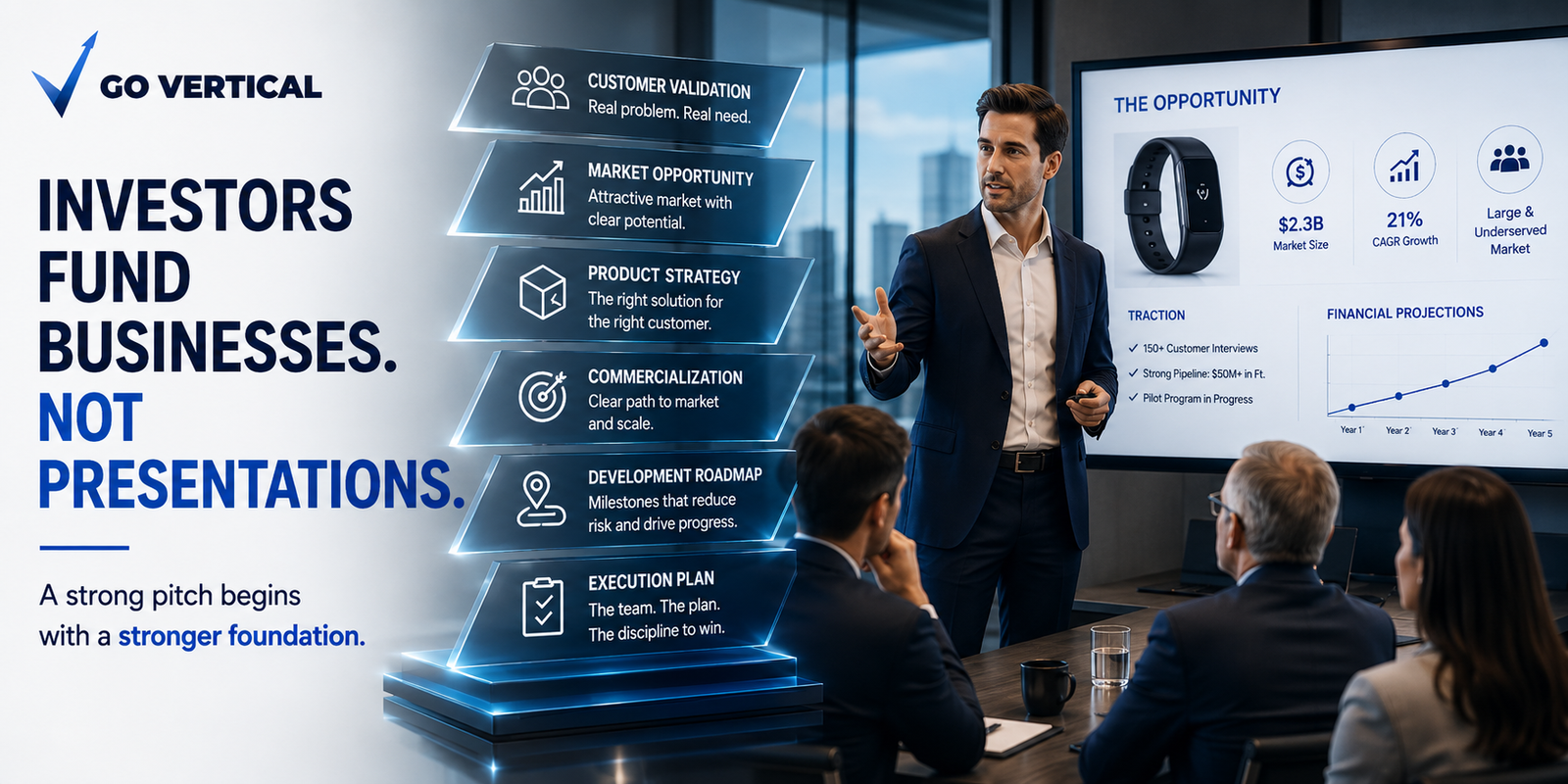
A polished pitch may open the door. Evidence, disciplined milestones, and a credible execution plan determine whether the opportunity can withstand investor scrutiny.
Problem
A specific, urgent problem with a clearly defined customer.
Evidence
Customer learning that reduces market uncertainty.
Roadmap
Milestones tied to technical and commercial risk.
Capital Logic
A precise explanation of what funding will unlock.
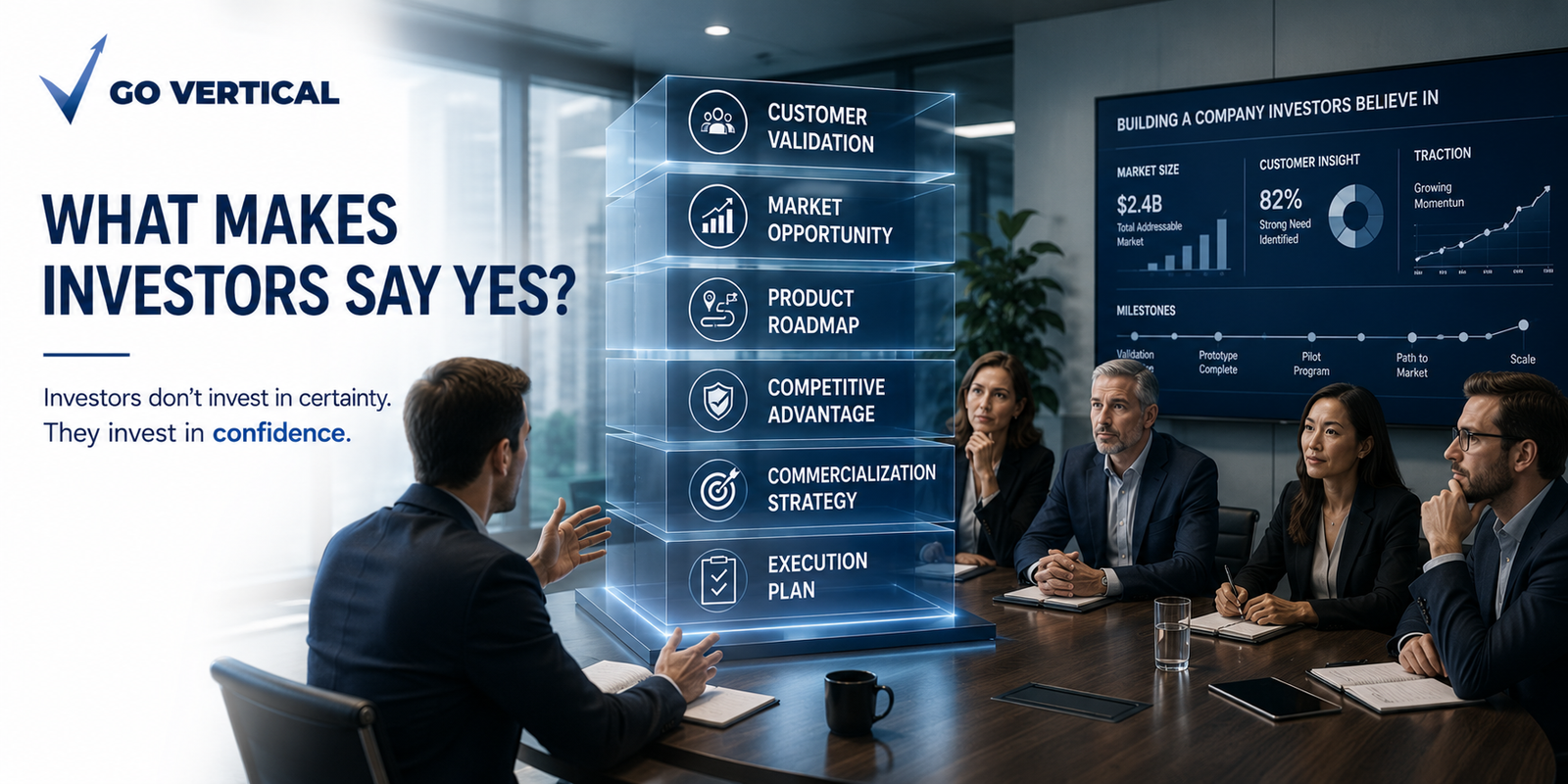
Investors Invest in Confidence
Investors understand that no startup is perfect.
They aren’t looking for certainty.
They’re looking for founders who understand their business well enough to navigate uncertainty.
That means demonstrating thoughtful decision-making across the entire business, not just the product.
By the time an investor meeting takes place, they want to see evidence that important questions have already been answered.
A Clear Problem Worth Solving
Every successful startup begins with a meaningful problem.
Before investors evaluate your solution, they want to understand the problem itself.
Questions they’ll often ask include:
- Who experiences this problem?
- How significant is it?
- How are people solving it today?
- Why does this problem deserve a new solution?
The stronger your understanding of the problem, the more credible your solution becomes.
Evidence That Customers Care
Founders naturally believe in their products.
Investors want to know whether customers believe in them too.
Customer validation doesn’t always require thousands of users.
Even at an early stage, investors appreciate founders who have:
- interviewed potential customers;
- observed user behaviour;
- gathered meaningful feedback;
- refined the product based on evidence.
Customer validation demonstrates that decisions are being guided by the market rather than assumptions.
A Realistic Market Strategy
Large markets often look impressive in presentations.
Focused market strategies are far more convincing.
Rather than trying to serve everyone, investors want founders who understand where they’ll begin.
Who is the first customer?
What market segment creates the best opportunity?
How will adoption happen?
Successful companies often start with a narrow focus before expanding.
A Roadmap That Makes Sense
Investors don’t expect founders to know every detail of the future.
They do expect founders to have a plan.
A credible roadmap demonstrates that development is intentional.
It answers questions such as:
- What happens next?
- What milestones need to be achieved?
- What risks remain?
- What does success look like over the next 12 months?
Roadmaps create confidence because they show disciplined thinking rather than reactive decision-making.
A Product That Can Be Defended
Competition exists in almost every market.
Investors aren’t looking for businesses without competitors.
They’re looking for businesses with a reason to win.
That advantage may come from:
- intellectual property;
- proprietary technology;
- customer experience;
- distribution channels;
- strategic partnerships;
- specialised expertise;
- speed of execution.
Defensibility demonstrates that the business can create long-term value rather than temporary attention.
Confidence in the Founding Team
Products change.
Markets evolve.
Founders adapt.
For that reason, investors spend significant time evaluating the people behind the business.
They look for founders who:
- learn quickly;
- communicate clearly;
- make informed decisions;
- accept feedback;
- solve problems;
- remain resilient when challenges arise.
A strong team often gives investors confidence that the company can navigate uncertainty successfully.
Execution Matters More Than Excitement
Passion is important.
Execution builds businesses.
Investors want founders who understand how ideas become products, products become businesses, and businesses become sustainable companies.
That requires more than ambition.
It requires discipline.
Every milestone achieved.
Every customer conversation completed.
Every assumption validated.
Every lesson learned.
These are the things that gradually reduce investment risk.
How Strategic Discovery Builds Investor Confidence
Many of the things investors care about are developed long before fundraising begins.
That’s why Strategic Discovery plays such an important role in building investor readiness.
Strategic Discovery helps founders strengthen:
- customer validation;
- market understanding;
- product strategy;
- commercialization planning;
- development priorities;
- competitive positioning;
- execution planning.
By the time founders begin raising capital, they’re no longer guessing.
They’re presenting a business built on evidence.
How GO Vertical ICM Structures the Pathway
GO Vertical ICM separates validation from execution so founders can make larger commitments only after the opportunity and priorities are clearer.
Stage One
Strategic Discovery
Assess the customer, market, technical feasibility, intellectual property, regulatory considerations, business model, risks, and investor-readiness gaps before major development.
Stage Two
Creation Accelerator Program
Once the direction is selected, advance product development, prototyping, manufacturing preparation, commercialization, and fundraising support through an execution roadmap.
Build the Evidence Before the Ask
Start with Strategic Discovery to determine what should be validated, developed, and funded next. When the pathway is ready for execution, CAP provides the next stage of structured support.