

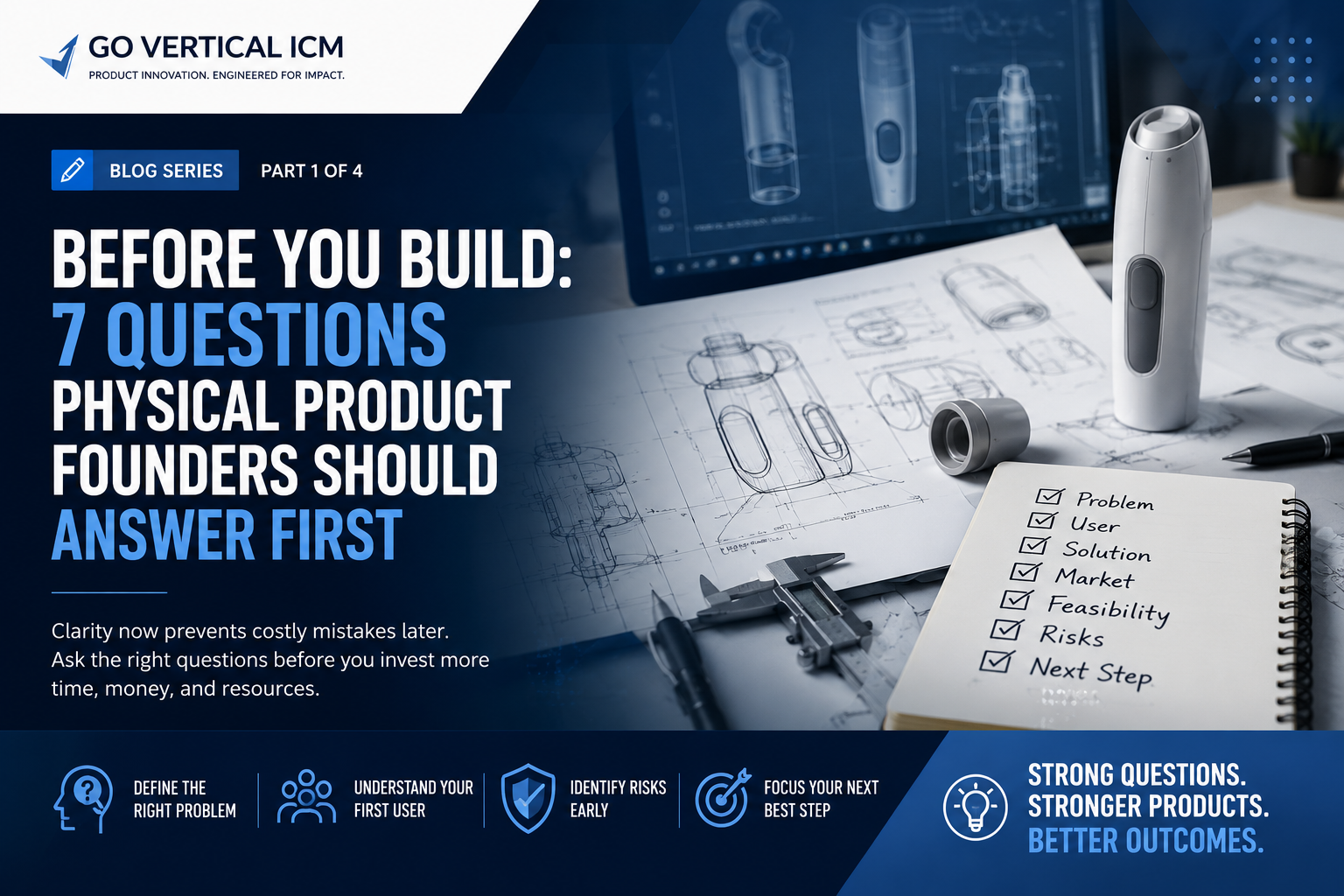
Founder Readiness Checklist
Seven Questions to Answer Before Development Accelerates
Clarity at the beginning reduces redesign, protects capital, and makes every later engineering and commercialization decision stronger.
User
Who experiences the problem, and in what context?
Value
Why is the solution meaningfully better than current alternatives?
Feasibility
What technical, regulatory, or manufacturing risks must be tested?
Milestone
What should the next investment of time and capital prove?
1–3: Problem, User, and Existing Alternatives
What exact problem are you solving? Who feels it most acutely? How do they solve it today? Specific answers reveal whether the opportunity is urgent and whether the product must outperform behavior, a competing product, or both.
4–5: Requirements and Feasibility
What must the product do to succeed, and which assumptions could make it unworkable? Consider performance, safety, usability, materials, cost, intellectual property, regulation, data, and integration needs.
6–7: Commercial Model and Next Decision
Who pays, how will the product reach them, and what evidence is required before you advance? The next milestone should unlock a defined decision—such as concept selection, prototype investment, pilot planning, manufacturing preparation, or fundraising.
How GO Vertical ICM Structures the Pathway
GO Vertical ICM separates validation from execution so founders can make larger commitments only after the opportunity and priorities are clearer.
Stage One
Strategic Discovery
Assess the customer, market, technical feasibility, intellectual property, regulatory considerations, business model, risks, and investor-readiness gaps before major development.
Stage Two
Creation Accelerator Program
Once the direction is selected, advance product development, prototyping, manufacturing preparation, commercialization, and fundraising support through an execution roadmap.
Build the Evidence Before the Ask
Start with Strategic Discovery to determine what should be validated, developed, and funded next. When the pathway is ready for execution, CAP provides the next stage of structured support.