

Leadership Perspective
Meaningful Innovation Requires Both Vision and Discipline
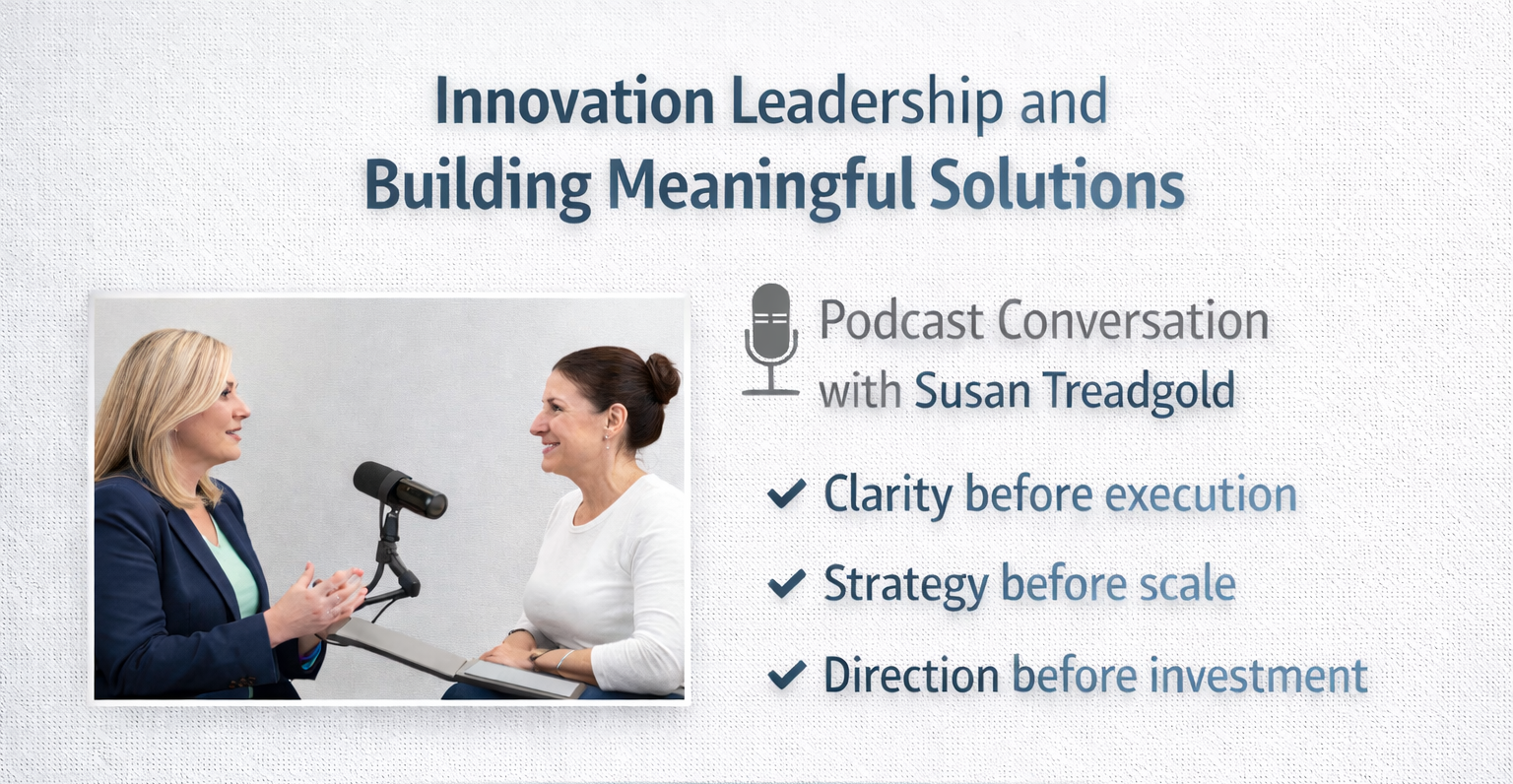
Hope Khoury’s conversation with Susan Treadgold explored how founders can connect purpose, customer needs, feasibility, and commercial execution.
Purpose
Begin with a problem whose consequences and users are clearly understood.
Evidence
Challenge assumptions through research, testing, and expert input.
Adaptability
Use new information to refine the product and development pathway.
Execution
Translate ambition into milestones, responsibilities, and measurable outcomes.
Leadership Beyond the Initial Idea
Innovation leadership is not limited to generating concepts. It requires making decisions with incomplete information, aligning specialists, and preserving the product’s purpose while responding to technical and commercial realities.
Balancing Ambition With Evidence
Founders working in healthcare, FemTech, and regulated markets must pair persistence with disciplined validation. The strongest leaders remain committed to the problem while staying flexible about the solution.
Building Solutions That Can Reach People
A meaningful innovation creates impact only when it can be developed, manufactured, adopted, and sustained. Product strategy must therefore connect user value with feasibility and a credible commercialization pathway.
From Insight to Structured Execution
GO Vertical ICM separates validation from execution so founders can commit larger resources only after the opportunity, risks, and priorities are clearer.
Stage One
Strategic Discovery
Validate the customer, market, technical feasibility, intellectual property, regulatory considerations, business model, risks, and investor-readiness gaps.
Stage Two
Creation Accelerator Program
Advance product development, prototyping, manufacturing preparation, commercialization, and fundraising through a structured execution roadmap.
Build With Evidence
Start with Strategic Discovery to determine what should be validated, developed, and funded next.